posted by Wizdo
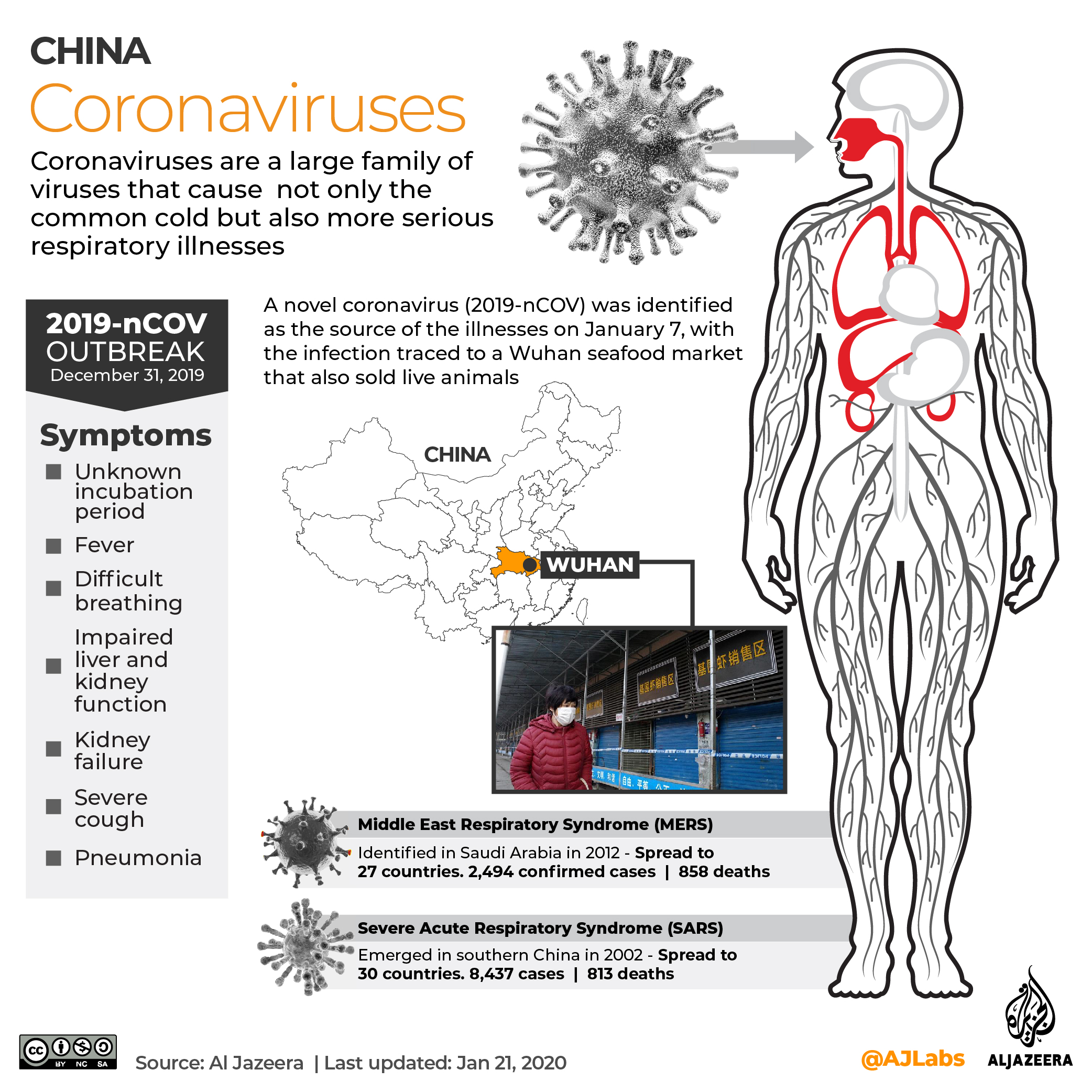
What is coronavirus?
According to
the WHO, coronaviruses are a family of viruses that cause illnesses
ranging from the common cold to more severe diseases such as severe
acute respiratory syndrome (SARS) and the Middle East respiratory
syndrome (MERS).
These viruses were originally transmitted between animals and people.
SARS, for instance, was transmitted from civet cats to humans while
MERS moved to humans from a type of camel.
Several known coronaviruses are circulating in animals that have not yet infected humans.
The name coronavirus comes from the Latin word corona, meaning crown
or halo. Under an electron microscope, the image of the virus looks like
a solar corona.
The novel coronavirus, identified by Chinese authorities on January 7
and since named COVID-19, is a new strain that had not been previously
identified in humans. Little is known about it, although human-to-human
transmission
has been confirmed.
What are the symptoms?
According to the WHO, signs of infection include fever, cough, shortness of breath and breathing difficulties.
In more severe cases, it can lead to pneumonia, multiple organ failure and even death.
Current estimates of the incubation period - the amount of time
between infection and the onset of symptoms - range from one to 14
days. Most infected people show symptoms within five to six days.
However, infected patients can also be asymptomatic, meaning
they do not display any symptoms despite having the virus in their
systems.
Read more on what the coronavirus does to your body if you catch it
here.
How deadly is it?
With more than 6,400 recorded deaths, the number of fatalities from
this new coronavirus has way surpassed the toll of the 2002-2003 SARS
outbreak, which also originated in China.
SARS killed about 9 percent of those it infected - nearly 800 people worldwide and more than 300 in China alone. MERS, which did not spread as widely, was more deadly, killing one-third of those it infected.
While the new coronavirus is more widespread than SARS in terms of
case numbers, the mortality rate remains considerably lower at
approximately 3.4 percent, according to the WHO.
Where have cases been reported?
Since March 16, more cases were registered outside of mainland China
than inside, marking a new milestone in the spread of the global
pandemic.
Deaths have been reported in host of nations, with Bahrain recording the first fatality in the Gulf on Monday.
The virus has spread from China to Asia-Pacific, Australia, Europe,
Middle East, Africa, North America, and Latin America, promting the WHO
to designate the COVID-19 outbreak as a pandemic
Human-to-human transmissions became evident after cases were recorded with no apparent link to China.
Read more about which countries have confirmed cases
here.
What is being done to stop it from spreading?
Scientists around the globe are
racing to develop a vaccine but have warned that one is unlikely to be available for mass distribution before 2021.
Meanwhile, Chinese authorities have effectively
sealed off Wuhan and
placed restrictions on travel to and from several other cities,
affecting some 60 million people. Other countries have since followed
suit with total lockdowns, closing schools, restaurants, bars, and
sports clubs, and also issuing mandatory work-from-home decrees.
International airlines
have cancelled flights the
world over. Some countries have banned non-citizens from entering their
territories and several more have evacuated their citizens from abroad.
Where did the virus originate?
Chinese health authorities are still trying to determine the origin
of the virus, which they say likely came from a seafood market in Wuhan,
China where wildlife was also traded illegally.
On February 7, Chinese researchers said the virus could have spread
from an infected animal species to humans through illegally-trafficked
pangolins, which are prized in Asia for food and medicine.
Scientists have pointed to either bats or snakes as the source of the virus.
Is this a global emergency?
The outbreak
constitutes a global health emergency, the WHO said on January 30, raising the alarm further when, on March 11, it
declared the crisis a pandemic.
The decision to sound the top-level alarm was made after the first
cases of human-to-human transmission outside China were confirmed.
The international health alert is a call to countries around the
world to coordinate their response under the guidance of the United
Nations health agency.
There have been five global health emergencies since 2005 when the
declaration was formalised: swine flu in 2009, polio in 2014, Ebola in
2014, Zika in 2016 and Ebola again in 2019.
Confused about the coronavirus? | Start Here
SOURCE:
Al Jazeera and news agencies